


When Someone Starts Snoring in a Sound Bath… 😴

Updated: Apr 16
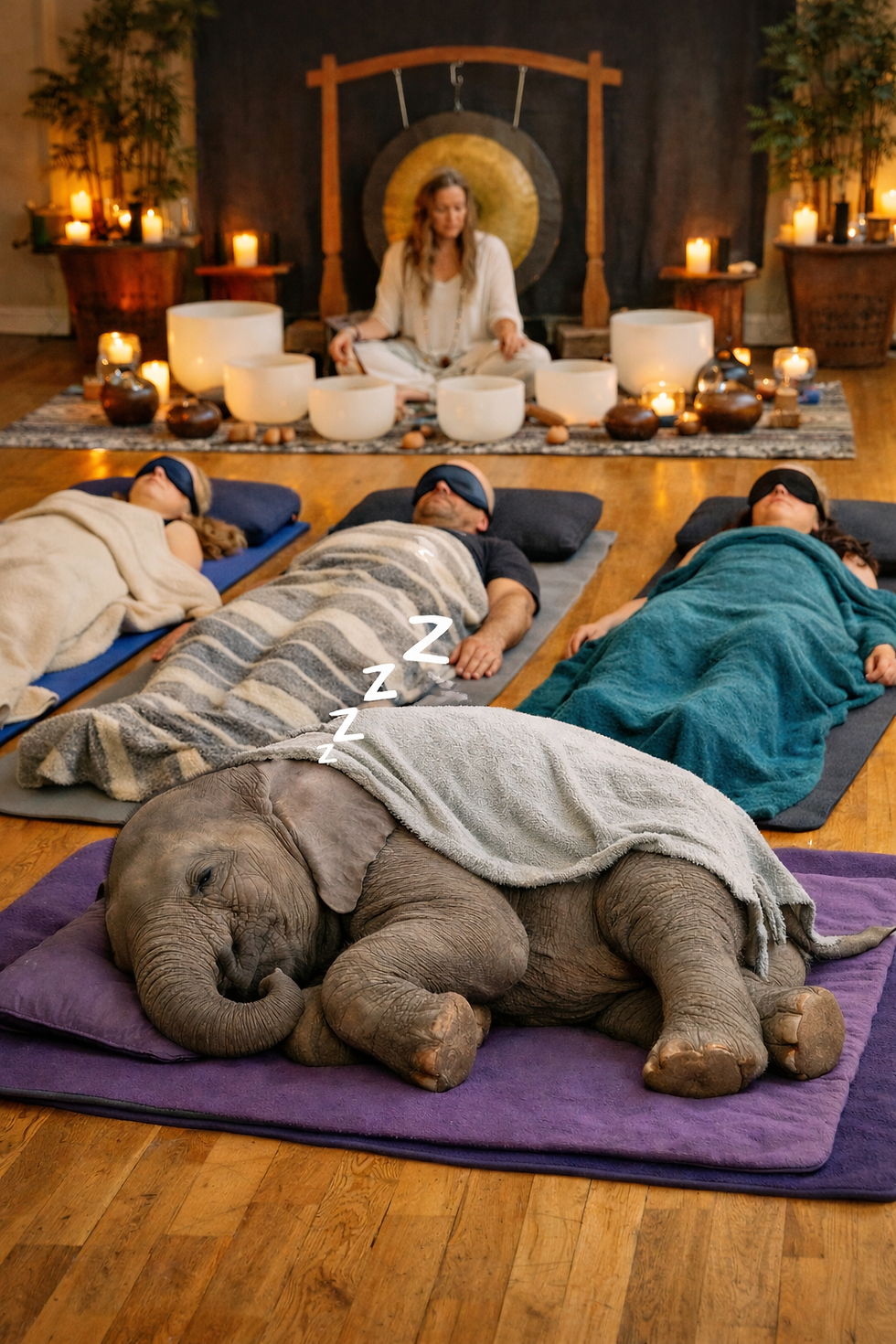
You’re floating in sound… Crystal bowls humming, breath slowing, body dissolving…
…and then—
someone starts snoring.
Loud enough to pull you out of your bliss.Subtle enough to make you question if it’s really happening.
The snoring elephant in the room. Hard to ignore… or is it?
Why Snoring Happens (Especially in Sound Baths)
Snoring isn’t random—it’s physiological.
When someone drops into deep relaxation, the body lets go in a way it rarely does in daily life:
The muscles in the throat relax
The airway slightly narrows
Breath creates vibration in soft tissue → sound (snoring)
But here’s the key:
Sound baths accelerate this process.
Through resonance, rhythm, and frequency, participants often shift into slower brainwave states:
Theta → deep meditation, dreamlike awareness
Delta → deep, restorative sleep
This is part of what makes sound healing so powerful.
So when someone snores, it’s often a sign of:
👉 The nervous system fully letting go
👉 The body entering deep restoration
👉 A level of surrender many people rarely reach
In simple terms:
They didn’t come to disrupt the session—they dropped all the way in.
Why It Feels So Disruptive
Here’s where it gets interesting.
In a sound bath, you’re surrounded by coherent, harmonic sound—think smooth sine waves, layered tones, intentional vibration.
Then suddenly:
👉 An irregular, unpredictable sound enters the field
Your awareness sharpens.Your nervous system notices the contrast.
This is why snoring can feel amplified—even more than in a café or office.
And yet…
In daily life, you already train this skill:
Working in busy environments
Staying focused in shared spaces
Tuning out background noise
The difference?
In meditation, the expectation is silence.
The Real Practice: Self-Regulation
This is where the deeper opportunity lives.
Snoring becomes a practice within the practice.
Instead of reacting:
Notice the sound
Feel your response
Choose your state
You can:
Let it pass through your awareness
Anchor deeper into the instruments
Even smile… knowing someone is receiving exactly what they needed
Because truly—
How often do we get the chance to stay groundedwhen something disrupts our ideal environment?
This is real-world meditation.

What To Do as an Attendee
If you are hearing it:
Acknowledge it (without resistance)
Return to the sound, breath, or body
Let it become part of the soundscape
Sometimes reframing helps: “That person is deeply resting.”
You can even use it as contrast—a reminder to drop deeper into coherence.
If you are the one snoring:
First—no shame.
It means your body trusted the space enough to let go.
But for group awareness:
Gently shift onto your side
Adjust the angle of your head
Slight repositioning can make a big difference
If it continues:
Sitting slightly upright can help
It’s a small act of respect for the shared field
What To Do as a Practitioner
This is where professionalism meets presence.
A well-held container includes preparing for this.
Before the session:
Set expectations:
Normalize that snoring can happen
Ask permission for light touch adjustments if needed
This alone reduces awkwardness later.
During the session:
If snoring arises:
Often it stops naturally after a few moments
If not, a gentle intervention works best:
✔ Light touch on the shoulder, arm, or above the knee
✔ Subtle cue—no abrupt waking
Never:
❌ Shake aggressively
❌ Startle the person
❌ Draw attention to them
If you have an assistant:
👉 Yes… this is where “snore patrol” comes in
A quiet, coordinated approach keeps the field intact.
When It Becomes Consistent
If someone continues to snore loudly and persistently:
Intervene gently, once or twice
If needed, adjust their position more clearly
The goal is balance:
Honor the individual’s releasewhile protecting the group experience
A Quick Note on the Science
Snoring can also be linked to:
Nasal congestion
Sleep position
Airway structure
Fatigue or sleep deprivation
But in the context of a sound bath, it’s often amplified by:
👉 Deep parasympathetic activation (rest-and-digest)
👉 Nervous system down-regulation
👉 Full-body relaxation
Which, ironically—
is exactly what you’re guiding people toward.
Final Thought
The snoring elephant in the room…
…might actually be proof the work is working.
And maybe the real question isn’t:
“Why is this happening?”
But:
“Can I stay centered anyway?”
Because when you can remain grounded—focused on your breath, your body, the sound— even when something pulls at your attention…
That’s not just a sound bath. That’s mastery of your state. Curious how I handled a private session where she snored the entire time—and why I kept playing? Read it here


Comments